
همین حالا تماس بگیرید!
پاسخ فوری و مشاوره رایگان در انتظار شماست.
The curtain is sewn and looks good on the window. But when opening and closing it gets stuck, one side hangs down, or the bottom edge curls. In such a situation, changing the fabric is not always the solution. It is often necessary to see if the rail, clamp, installation location and bullet lead are compatible with the weight and sewing method of the curtain.
For someone who buys curtains in Varamin or compares options before buying from Tehran market, the number of names may make the decision more difficult. The main criterion is simpler than a long list of products: each part must perform a specific task in a coordinated assembly.
On what basis should we choose curtain essentials?
Curtains must be selected according to the type of fabric, final weight, sewing model and installation location; Not just with the appearance or the price of each piece. The rail should have proper movement and weight bearing, the clamp should be compatible with the rail and curtain tape, and the ball lead should be used only when the form of the bottom edge of the curtain requires it.
Before preparing curtain accessories, answer four questions:
- Is the curtain light or multi-layered and heavy?
- Will the curtain be installed from the ceiling or the wall?
- Is it supposed to move every day or will it stay more fixed?
- What shape does the bottom edge of the curtain have after sewing?
Answering these questions will determine what is necessary and what will be just an extra cost.
It is better to see curtain hanging system as a complete set. The rail itself may be sound and well-made, but an ill-fitting hook or clip will get in the way. Also, bullet lead may show the bottom of a silk curtain more neatly, but it cannot compensate for measurement errors or asymmetrical stitching.
The right choice starts with identifying the problem, not adding more parts.
What do the rail, clip and bullet lead each do?
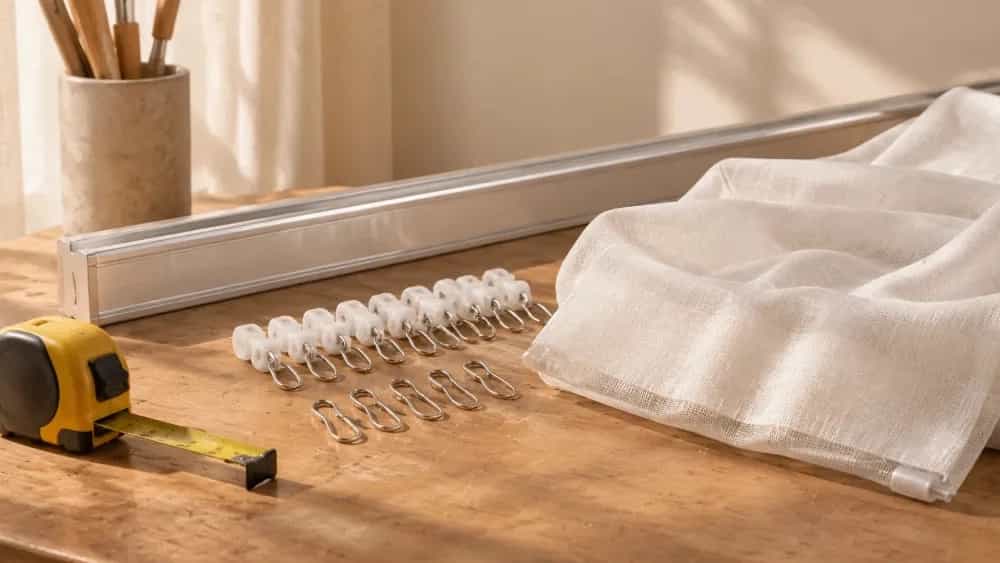
The rail creates the movement path of the curtain, the clip connects the fabric to the rail, and the ball lead helps stabilize the lower edge of the curtain. These parts do not replace each other, and their proper performance depends on their compatibility with each other and the installation method.
When comparing products, the phrase "suitable for curtains" alone is not enough. The dimensions of the movable part, the shape of the rail opening, the model of the curtain strip and the material of the installation surface should be checked before purchase; Especially if a part of the equipment is going to be added to an existing curtain or rail.
rails and clamps; Compatibility is more important than appearance
The suitable rail should move the desired curtain smoothly and be installed on a firm surface. The clip or moving part should also be compatible with the same rail and curtain connection method; The appearance of two pieces does not guarantee their proper fit or movement.
For a curtain that opens and closes frequently, don't test the movement with just a few centimeters of track. Pass the moving part from the beginning to the end of the track and pay attention to the following:
- Stuck on the track
- Abnormal noise
- Part sticking out
- Difficulty moving
- Inappropriate distance of clamps
- Stopping at the junction of two rails
If the curtain is heavy or multi-layered, ask the dealer or installer about the reliable capacity of the rail assembly, base, connection and mounting surface. You can't guess the weight bearing just from the appearance of the rail.
Installation location is also a part of choosing curtain accessories. Masonry wall, plaster surface and false ceiling do not have the same conditions. Before drilling, the location of the support and the possible path of the wire or pipe should be checked, and the type of connection should be compatible with the material under the work.
For installation on false ceilings or precarious surfaces, the discernment of an experienced installer is more important than choosing a seemingly solid screw.
bullet lead; Adjust the bottom form of the curtain
Bullet lead is used to help the bottom edge of some curtains fall and stay neat. This piece is usually placed in the sewn part of the bottom of the curtain; But the amount and method of using it should be in harmony with the fabric and sewing style.
In a light curtain, first check if the problem is really a lack of edge weight or if it comes from other factors such as these:
- Uneven height of the curtain
- Puckering of the bottom seam
- Irregular sewing
- Improper ironing
- Inconsistent arrangement
- Incorrect rail installation
Adding weight to a fabric with a seam defect may only make the defect more apparent. In a thick curtain, making the edge heavier does not necessarily create a more beautiful drop.
It is better to sample and hang a short part of the curtain before the final sewing. With this, you can better evaluate the shape of the edge, the amount of folds and the real need for weighting.
Don't take the name "bullet lead" as the definitive specification of all products. Ask for the material, coating, size and method of enclosing the part inside the rim when purchasing. If the product is made of lead, it should not remain in the form of detachable or accessible pellets.
Part or decision | When is it more important? | What should we check before we prepare? | Choice mark Unsuitable |
Curtain rail | Heavy, multi-layered or busy curtain | Curtain weight, track length, installation type and compatibility of moving parts | Bending, loud noise or jerky movement |
Clips and hooks | Pleached stitching or connection to existing rail | Curtain strip model, rail opening and method Hanging | Stuck or irregularly standing folds |
Base and connections | Installation on a wall, ceiling or on a safe name | The material of the surface, the place of support and the method of restraint | Looseness of the set after use |
Bullet lead | The edge of the light curtain that is still good after repairing the stitching Does not stand | Materials, suitable weight and possibility of enclosing at the edge | Stretching, protruding or visible weights |
Sampling before complete installation | multi-window orders or change of curtain model | movement of a part of the rail and drop of a piece of fabric | repetition of a problem in all windows |
Unsaid tricks and costly mistakes
In my experience, most rework starts where individual pieces have been selected, but the compatibility of the set has not been checked. Before committing to an order, I prefer to know how the curtain is sewn, where it will be installed, and what problem the new piece is going to solve.
I, Sami Bagheri, in the business of selling and distributing curtain accessories in Tek Classic Bagheri Production, I consider one recommendation more important than introducing a list of products: if a part is going to be added to the existing system, bring a sample of the current rail or clip with you.
Descriptions such as "common rail" or "standard clip" are not sufficient to determine exact compatibility. A clear photo of the cross-section of the rail and moving part is also better than ordering based on the product name alone.
The second mistake is judging the bullet lead before hanging the curtain. The cloth on the table and the cloth hanging from the rail are not seen the same.
I suggest checking the following first:
- Height of the curtain
- Bottom line of the curtain
- State of the seams
- Distance of the folds
- How the curtain stands on both sides
- The amount of fabric drop after hanging
After this check, if the edge still does not have the desired shape, test the weighting on a small section. This arrangement reduces the risk of unnecessary handling of a healthy curtain.
The third point is related to safety. If the curtain or window covering is operated by straps and chains, the neat appearance of the strap does not mean that it is secure. In places where there is a possibility of access, the route of straps should be checked and safer systems without straps should be used as much as possible.
This is about the straps and chains of curtain systems and is different from the clip or lead sewn into the edge of the curtain. However, the bullet lead must also be properly enclosed inside the edge of the curtain so that it cannot be detached.
A road map for choosing and installing curtains
Start by measuring and diagnosing the problem, then select compatible parts together and test on a section. Buying the entire thing before checking rail movement and fabric form, especially for multiple similar windows, increases the chance of repeating a mistake.
First step: determine the characteristics of the curtain
The type of fabric and the final weight of the curtain are the first criteria for choosing curtain accessories. Without knowing these two factors, the selection of rails and accessories is mostly based on guesswork.
Note the following:
- Fabric material
- Number of layers
- Approximate curtain weight
- Strip or sewing model
- Daily usage rate
- Preferable shape of folds
- Fixed or movable curtain
- Curtain opening type from the middle or side
If there is a curtain, specify the exact cause of dissatisfaction. For example, say the curtain gets stuck, hangs crooked, has a wave at the bottom, or the folds are not even.
Step 2: Check the installation location
The length of the rail should be measured based on the actual installation location, not just the width of the glass. The distance to the window handle, side walls, nearby fixtures and the possibility of full curtain movement should also be considered.
When checking the installation location, pay attention to the following:
- Type of wall or ceiling
- Presence of false ceiling
- Distance from window to ceiling
- Distance from window to side walls
- Location of window opening
- Existence of closet, heater or nearby appliances
- Number of bases required
- Connection of rails
Don't guess about the strength of the mounting surface. For uncertain work, it is better to consult an installer or expert before buying parts.
Step 3: Adjust the rail and moving parts
The rail, clamp, hook and base should be checked as a set. Buying any part of a different model may cause the curtain to snag or make extra noise when moving.
If you are keeping an existing rail, use a sample or cross-section photo as the basis for choosing a clamp. If you are making a new set, check the compatibility of the rail, moving part, clamp and base together.
Step 4: Evaluate the bottom of the curtain
Check for sizing and stitching issues before using bullet lead. Weighting should not be used to hide stitching errors or uneven curtain length.
After hanging the sample:
- Check the bottom line of the curtain.
- See the drop of the fabric from the right distance.
- Compare the corners with the middle part.
- Check the amount of creases.
- Check for stretch or protrusion.
If the hem still doesn't have the desired shape, try the bullet lead on a short section. After seeing the result, decide on the full implementation.
Step 5: Test before full implementation
Testing one part of the assembly will significantly reduce the cost of correcting a mistake. Move the curtain several times along the entire path and check its form in daylight.
In this step, check the following:
- Smoothness of curtain movement
- Rail noise
- Stuck clips
- Loose legs
- Rail bending
- Even fabric fall
- Appropriate distance between curtain and window
- Complete closing of both sides of curtain
If a sample window has the desired result, record the same specification for similar windows.
To discuss the supply of curtain accessories in Varamin, having the sizes, the picture of the installation location and the sample of the available parts helps to make a more detailed request. This preparation makes the conversation from "What product do you have?" To "What collection is compatible with this curtain?" change.
Conclusion and final opinion
Curtain accessories have been selected correctly when the curtain moves smoothly, stands neatly and its connection is suitable for the installation location. Rail, clip and bullet lead each solve a different problem, and adding an unrelated part does not replace the diagnosis of the cause.
I, Sami Bagheri, suggest that you prepare three things before purchasing curtain accessories:
- Fabric specifications and its approximate weight
- Image or sample of available parts
- Exact size of installation location
With this information, whether you consult in Varamin for supplies or weigh the options in the Tehran market, the conversation will be more accurate.
If you are in doubt about choosing a piece, first describe the problem that the curtain represents in action; Stuck, stiff movement, erratic drop, uneven folding or loose connection. The professional selection of curtain essentials begins with this simple diagnosis.